Why the 4GB Variant is the Professional Choice
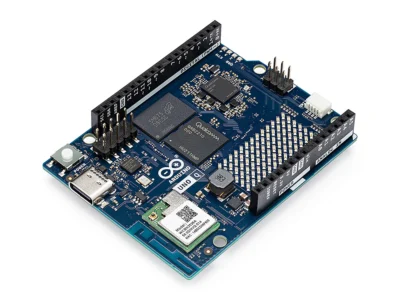
While the UNO Q series offers versatility, the 4GB RAM / 32GB eMMC model is the definitive version for developers who refuse to compromise:
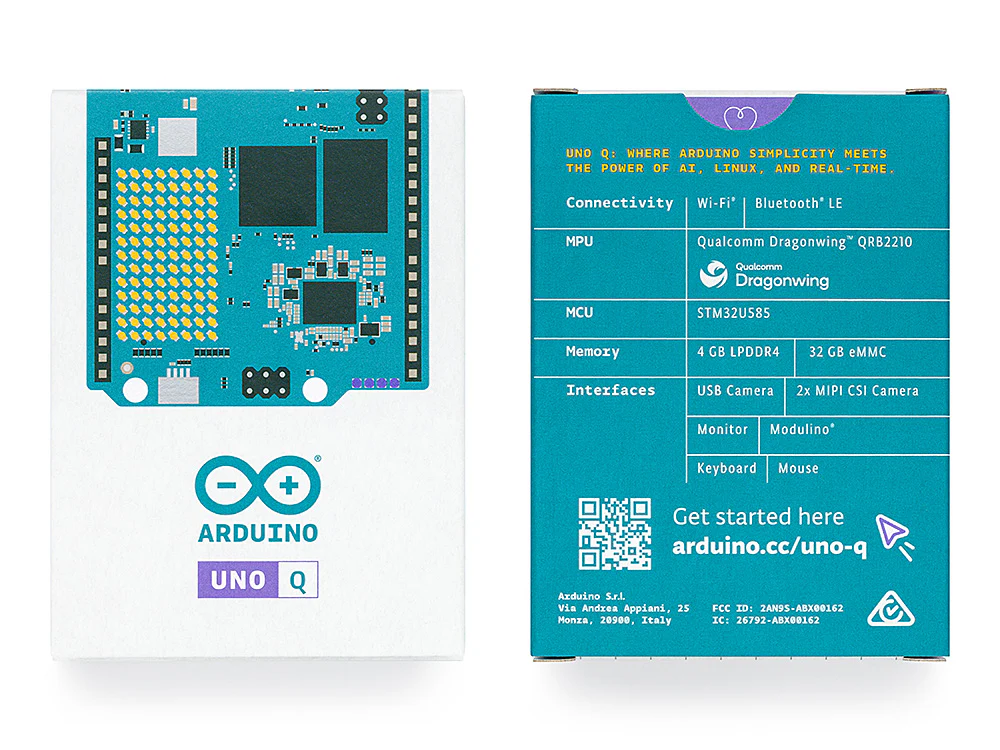
- Massive Memory: 4GB of LPDDR4 RAM allows you to run multiple Linux containers, Python scripts, and AI models simultaneously without bottlenecks.
- High-Speed Integrated Storage: Forget unreliable SD cards. The built-in 32GB eMMC ensures fast OS boot times and secure data logging.
- Advanced Multimedia: Smoothly handle dual-camera feeds and high-definition displays via integrated MIPI interfaces.
Dual-Brain Architecture: The Best of Both Worlds
The UNO Q 4GB features a unique “Split-Processing” design that allows you to manage tasks where they belong:
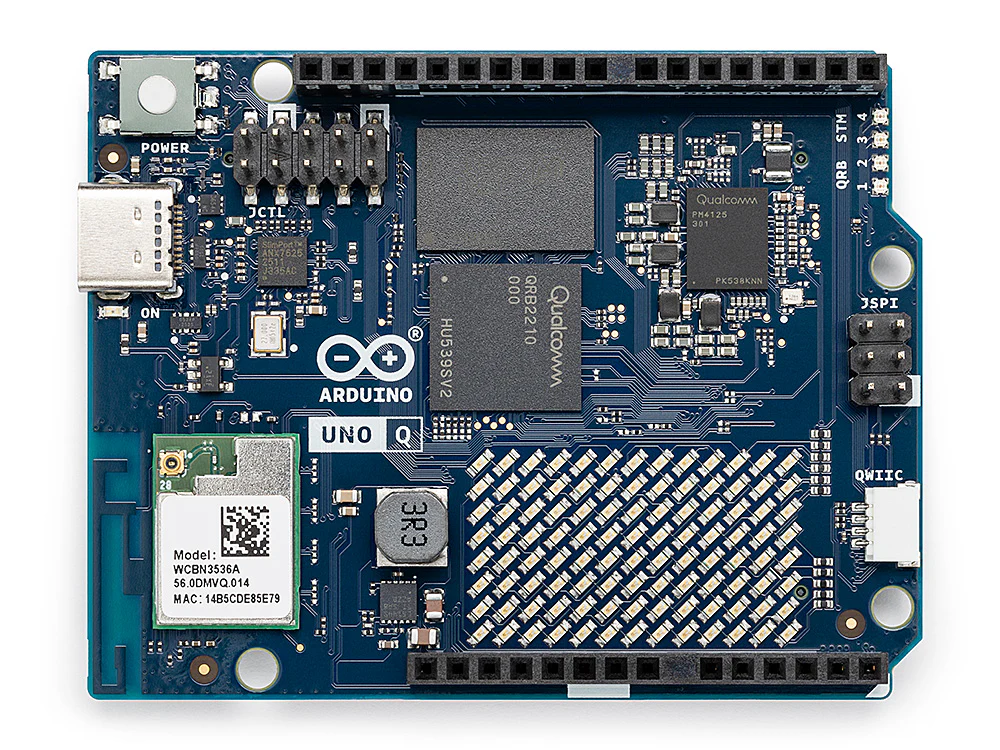
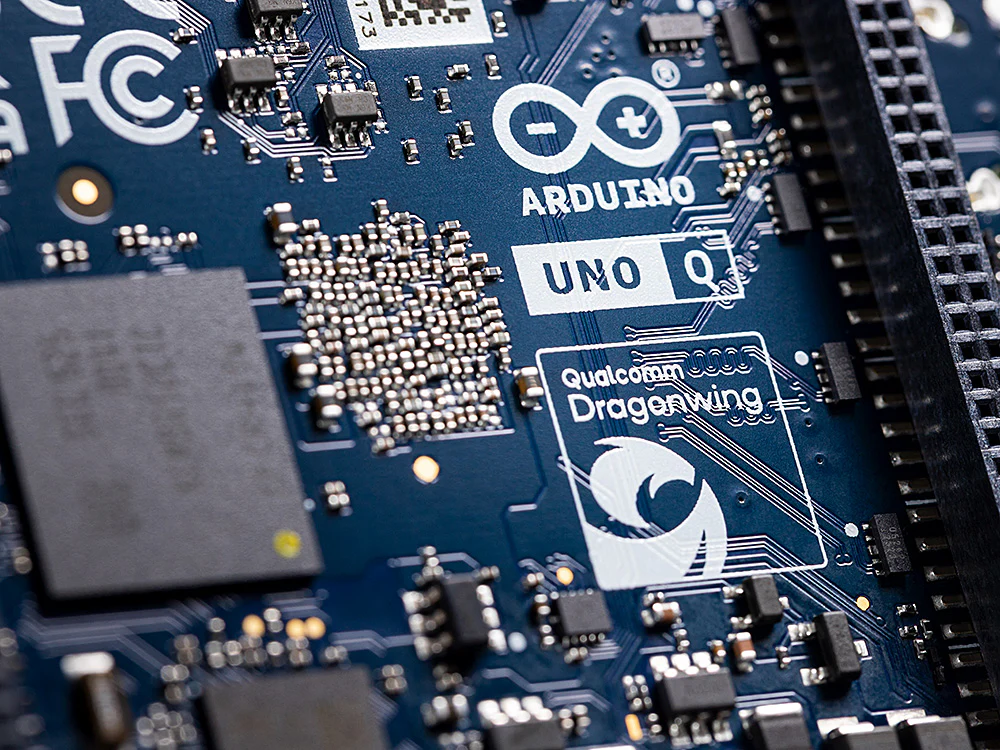
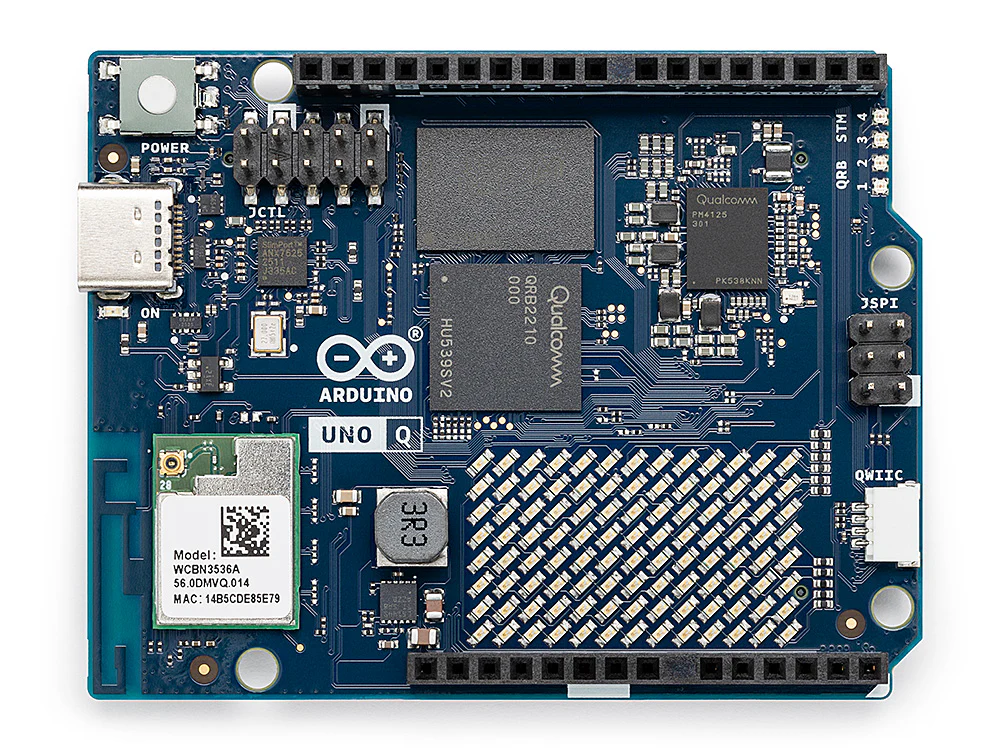
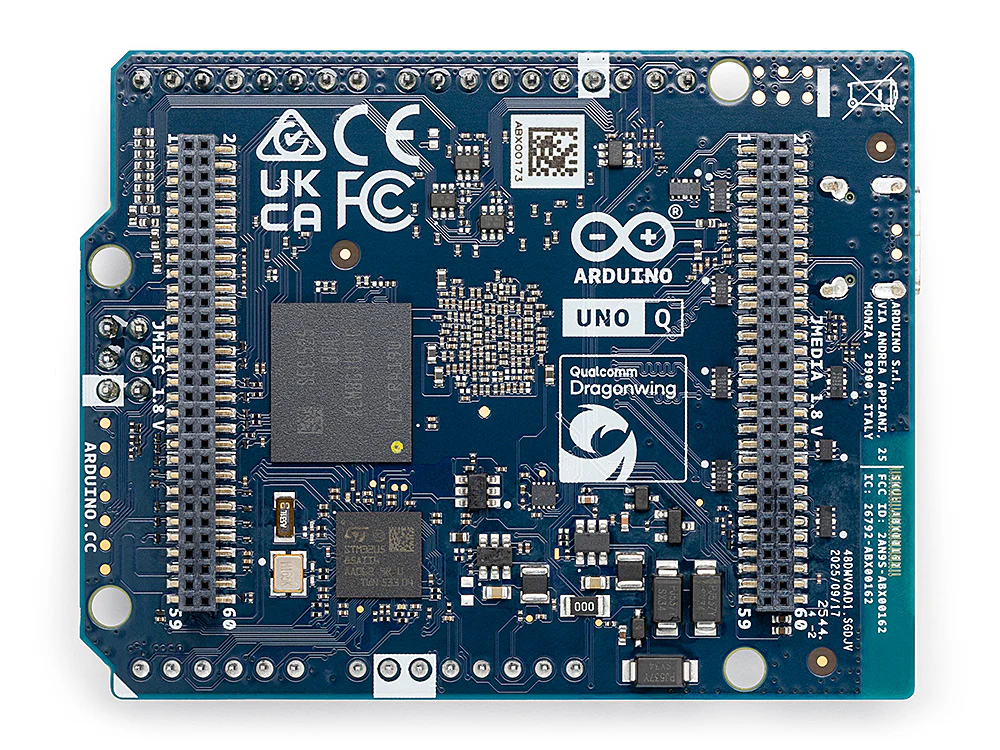
1. The High-Level Brain (MPU): Powered by the Qualcomm® Dragonwing™ QRB2210 (Quad-core 64-bit ARM® Cortex®-A53). It runs a full Debian Linux environment, perfect for AI frameworks, web servers, and complex data processing.
2. The Real-Time Brain (MCU): Powered by the STM32U585 (Cortex®-M33). It manages the I/O, sensors, and time-critical hardware tasks with the legendary reliability of the Arduino ecosystem.
The Arduino App Lab: Your Bridge to Innovation
One of the most powerful features of the UNO Q 4GB is the Arduino App Lab. This software suite simplifies the management of your hybrid system:
- Simplified Interconnect: Skip the complexity of low-level coding. Easy, high-level management of Linux (MPU) and Arduino (MCU) communication, making integration faster than ever.
- Flexible AI Execution: Get your models up and running in seconds. Deploy directly to the Qualcomm® processor, utilizing its high-performance CPU and GPU architecture for efficient machine learning tasks.
- Real-Time Dashboard: Monitor CPU temperature, memory usage, and pin status via a sleek, web-based interface.
Applications & Use Cases
- Edge AI & Vision: Real-time object detection, facial recognition, and autonomous drone navigation.
- Industrial IoT Gateway: Securely aggregate data from local sensors and process it locally before cloud synchronization.
- Professional Prototyping: The perfect platform for building smart home hubs, media controllers, or advanced 3D printer interfaces.
Looking for lower cost with balanced performance?
Check out the Arduino UNO Q 2-GB variant.
Tech specs
| Microprocessor (MPU) |
Qualcomm Dragonwing™ QRB2210:
Quad-core Arm® Cortex®-A53 @ 2.0 GHz
Adreno GPU 3D graphics accelerator
2x ISP (13 MP + 13 MP or 25 MP) @ 30 fps |
| Microcontroller (MCU) |
STM32U585
Arm® Cortex®-M33 up to 160 MHz
2 MB flash memory
786 KB SRAM |
| RAM |
4GB LPDDR4 |
| Power Supply |
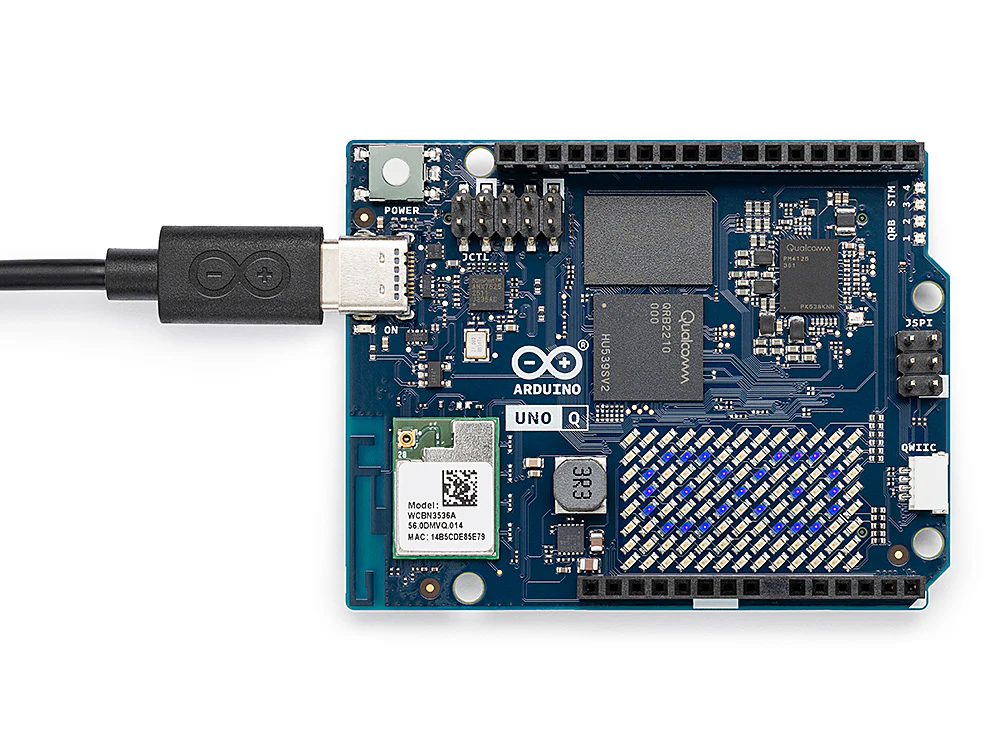
From USB-C connector 5 V max at 3 A
Input Voltage (VIN): 7-24 V |
| Storage |
32GB eMMC |
| USB |
1× USB-C port with host/device role switching, power role switch and video output |
| Connectivity |
Wi-Fi® 5 2.4/5GHz with onboard antenna
Bluetooth® 5.1 with onboard antenna |
| Interfaces |
I2C/I3C
SPI
PWM
CAN
UART
PSSI
GPIO
JTAG
ADC |
| Video |
Video output support via USB-C
MIPI DSI pins on JMEDIA header |
| Extra |
4× RGB user-controllable LEDs
8×13 Blue LED Matrix
1x Qwiic connector voltage 3V3, I2C
1x User push-button
JCTL: MPU Remote Debug connector |
| Audio |
Microphone IN / Headphone OUT / Line OUT on JMISC |
| Dimensions |
68.85 mm x 53.34 mm (UNO form factor) |
| MPU Operating System |
Linux Debian OS with upstream support |
| Real-time Operating System |
Arduino Core on Zephyr OS |
| Containerization |
Docker and Docker Compose support |
| Support Operating Systems for Arduino App Lab |
Windows: Windows 10 or later (64-bit)
macOS: macOS 11 or later (64-bit)
Linux: Ubuntu 22.04 or later, and Debian Trixie (64-bit) |
There are no reviews yet.